
Phylogenetics infers evolutionary trees from taxonomic data, and every tree it produces is a hypothesis. Jackknifing is one way to test one: leave some of the taxa out at random, rebuild the tree, and do it again many times over. The groupings that hold up across the runs are the ones the evidence supports. The idea goes back to Scott Lanyon's 1985 paper on detecting internal inconsistencies in distance data, and Cicero and Johnson's 2001 vireo phylogeny is the worked example the project proposal pointed to. A single analysis produces something like ten thousand trees, and someone has to sort through them.
Mark Westneat Mark WestneatProfessor of organismal biology and anatomy at the University of Chicago, working on the evolution and biomechanics of fishes. Formerly chair of zoology and director of the Biodiversity Synthesis Center at the Field Museum.LinkedIn ↗, then Associate Curator of Zoology at the Field Museum of Natural History, had written JackTaxa in Pascal to do this for his coral reef fishes. It was the only tool anyone knew of for automated jackknifing of phylogenetic data. He wanted it in Java so it would run on his Mac and could be shared with other biologists. I built that version from scratch, with Dr. Westneat as the client.
What it does
The window has two tabs, in the order the work goes, and a settings dialog for the PAUP script that wraps each run: its header, its footer, and how taxa are named.
Simulation loads the taxa from a NEXUS file, sorts them into included, excluded, and jackknifed, and takes the number of iterations. Pressing the button writes a command file with every run in it. JackTaxa does not build trees itself: that file goes to PAUP, which produces a tree file.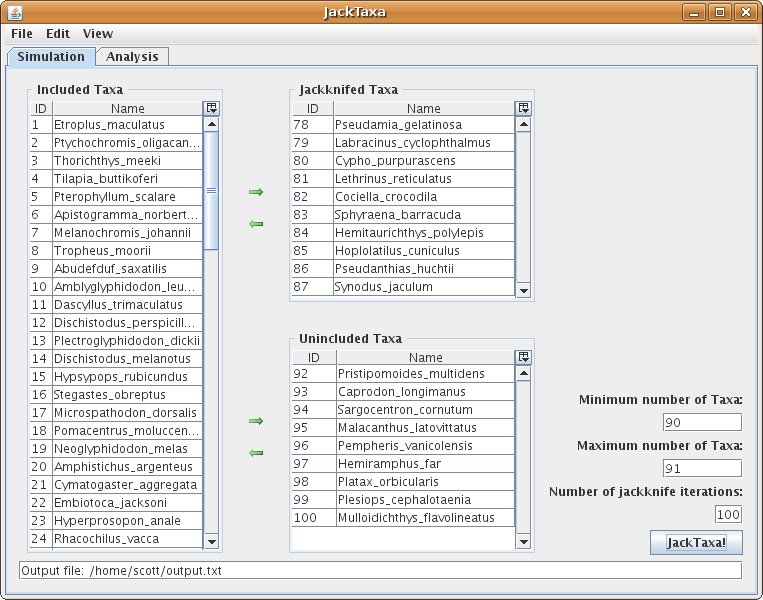
Analysis loads the tree files that come back. Pick a tree and a clade in it, and Find Clade splits every tree into those that contain the clade and those that do not. Find Resolved Clade also requires the same topology inside it. Calculate Distances gives the Robinson-Foulds distance from the selected tree to each of the others, and any of the lists can be written back out as a NEXUS file for the next step.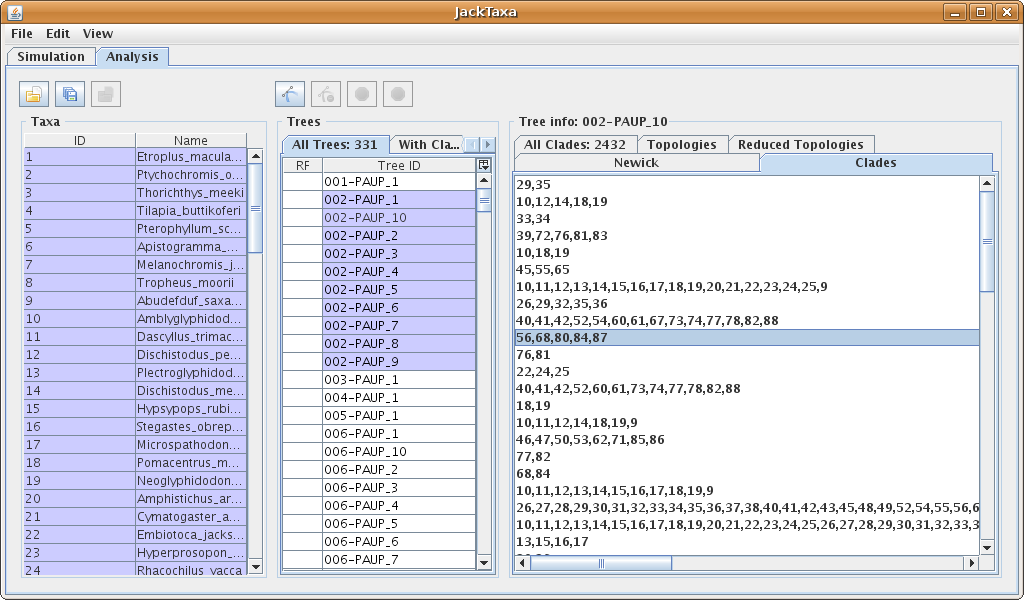
Two courses of research
JackTaxa was two courses of graduate research for my master's at DePaul, from September 2006 to November 2008. The first, a research practicum in computational biology, produced the first working version and a design paper. The second, the computer science research option, carried it toward a finished, distributable application. David Sigfredo AnguloDADavid Sigfredo AnguloGrid-computing researcher who ran the Illinois Bio-Grid and taught computer science at DePaul; earlier on the Globus work at the University of Chicago, later a data architect in industry.LinkedIn ↗ and Joseph Phillips Joseph PhillipsComputer scientist at DePaul University working on computational scientific discovery: algorithms and systems that help scientists understand, compute with, and extend scientific models. Ph.D. in AI from Michigan; earlier a chemist and a programmer at Lawrence Livermore.DePaul faculty page ↗ advised the research; Dr. Westneat set the requirements.
Built with
Java Swing, on Java 1.5 and then 1.6, built in NetBeans with Ant and kept in Subversion. The phylogenetics libraries were PAL, BioJava, and PhyloNet, with SwingX and Spring Rich Client for the interface. The engineering documents, a proposal, a requirements specification, a feature set, use cases, CRC cards, and a class diagram, follow the ReadySet templates.