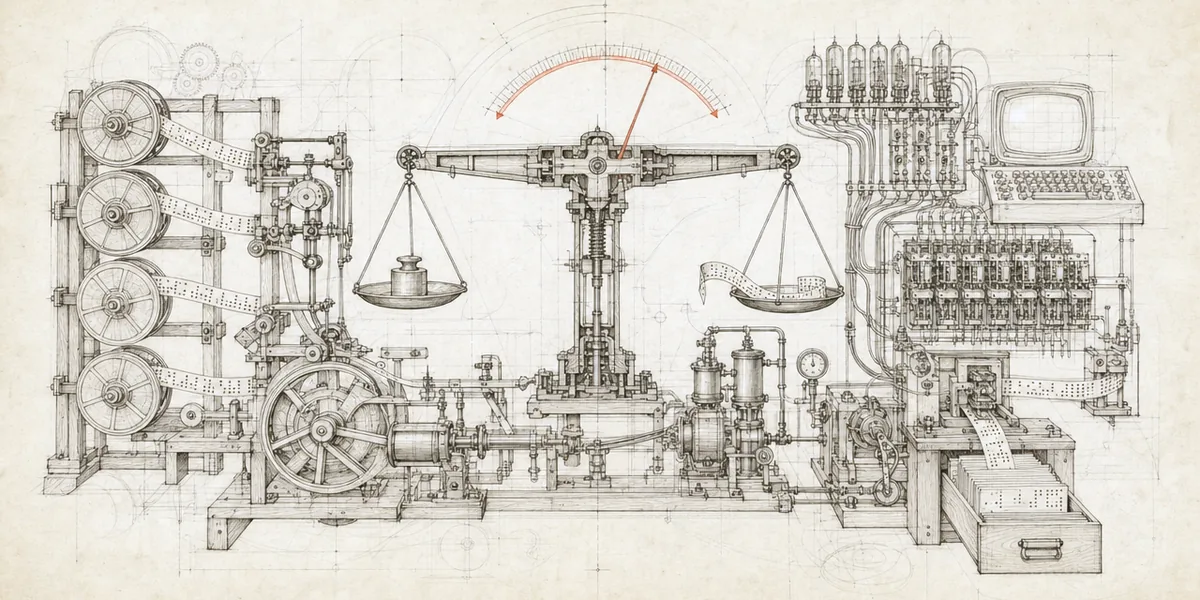
ADAMA stands for Autonomous Dynamic Analysis of Metaphor and Analogy. It was a system for finding metaphors in large amounts of text, in four languages, and working out what they meant.
The idea came from IARPA's Metaphor program. People show how they think about a subject in the metaphors they use for it, and so does a culture. If a system could find those metaphors in the text a population writes online, analysts could read them for the beliefs underneath. The four languages were American English, Iranian Farsi, Mexican Spanish, and Russian.
Approach
The system read very large amounts of online text and pulled out the metaphors in it. Psychologists and cultural experts reviewed what it found, and the results went into a repository of the metaphors each language uses. The software did the part that only works at scale. The experts decided what a metaphor said about the people who used it.
The intended users were in forensics, intelligence analysis, business analysis, sociological research and communication studies.
The project
Led by Shlomo Argamon Shlomo ArgamonComputational linguist. Associate Provost for AI and dean of the Graduate School of Technology at Touro University; before that professor of computer science at Illinois Tech, where he led ADAMA.LinkedIn ↗ at the Illinois Institute of Technology, with the Massachusetts Institute of Technology, Georgetown University, Ben-Gurion University of the Negev, Bar-Ilan University, and the Center for Advanced Defense Studies.
Andrew OrtonyAOAndrew OrtonyProfessor emeritus at Northwestern, a psychologist known for his work on metaphor and for the OCC model of emotion, set out in The Cognitive Structure of Emotions.LinkedIn ↗ of Northwestern University, a psychologist whose work is on metaphor and on emotion, consulted to the project in 2013 and 2014. He is a co-author of the team's 2014 paper on language-independent ensemble approaches to metaphor identification. Illinois Tech also announced Marvin Minsky Marvin MinskyCo-founder of MIT's artificial intelligence laboratory and a Turing Award winner; one of the founders of AI as a field. Died in 2016.Wikipedia ↗ joining the project in December 2012.
The work ran under IARPA — the Intelligence Advanced Research Projects Activity — through the U.S. Army Research Laboratory, from January 2012 to January 2014. Illinois Tech announced it in April and May of 2012.
Role
Contract programmer, 2012 to January 2014 — NLP development at the Linguistic Cognition Laboratory, building the affect classification subsystem within the Java system that detected and extracted metaphor from text.
Worked alongside Shlomo ArgamonShlomo ArgamonComputational linguist. Associate Provost for AI and dean of the Graduate School of Technology at Touro University; before that professor of computer science at Illinois Tech, where he led ADAMA.LinkedIn ↗, Sergey KanareykinSKSergey KanareykinTechnologist and entrepreneur at Euclid Techlabs, building medical and electron-beam devices. Worked on ADAMA through the Brain Sciences Foundation and co-authored its metaphor identification papers.LinkedIn ↗, Matthew TaylorMTMatthew TaylorSoftware engineer and facilitator in learning technology, at i2 Learning. Worked on ADAMA's affect classification software from 2012 to 2014.LinkedIn ↗, Amin RasooliARAmin RasooliResearcher in Argamon's group at Illinois Tech; co-author of work on profile-based authorship analysis.LinkedIn ↗, and Lisa GandyLGLisa GandyAssociate professor of computer science at Kettering University, formerly at Central Michigan. Her research applies natural language processing to social media and text analysis. PhD from Northwestern.LinkedIn ↗.

The lab worked where machine learning meets computational linguistics. Its subject was the non-referential side of text: how a document is organized and styled, apart from what it is about, and how that style varies between individuals and groups.
Further reading
Argamon's group published this research while the system was being built.
- Automatic Identification of Conceptual Metaphors with Limited Knowledge — Gandy et al., AAAI 2013
- Language-Independent Ensemble Approaches to Metaphor Identification — Dunn et al., AAAI 2014 workshop on Cognitive Computing
- Metaphor Identification in Large Texts Corpora — Neuman et al., PLOS ONE, 2013